


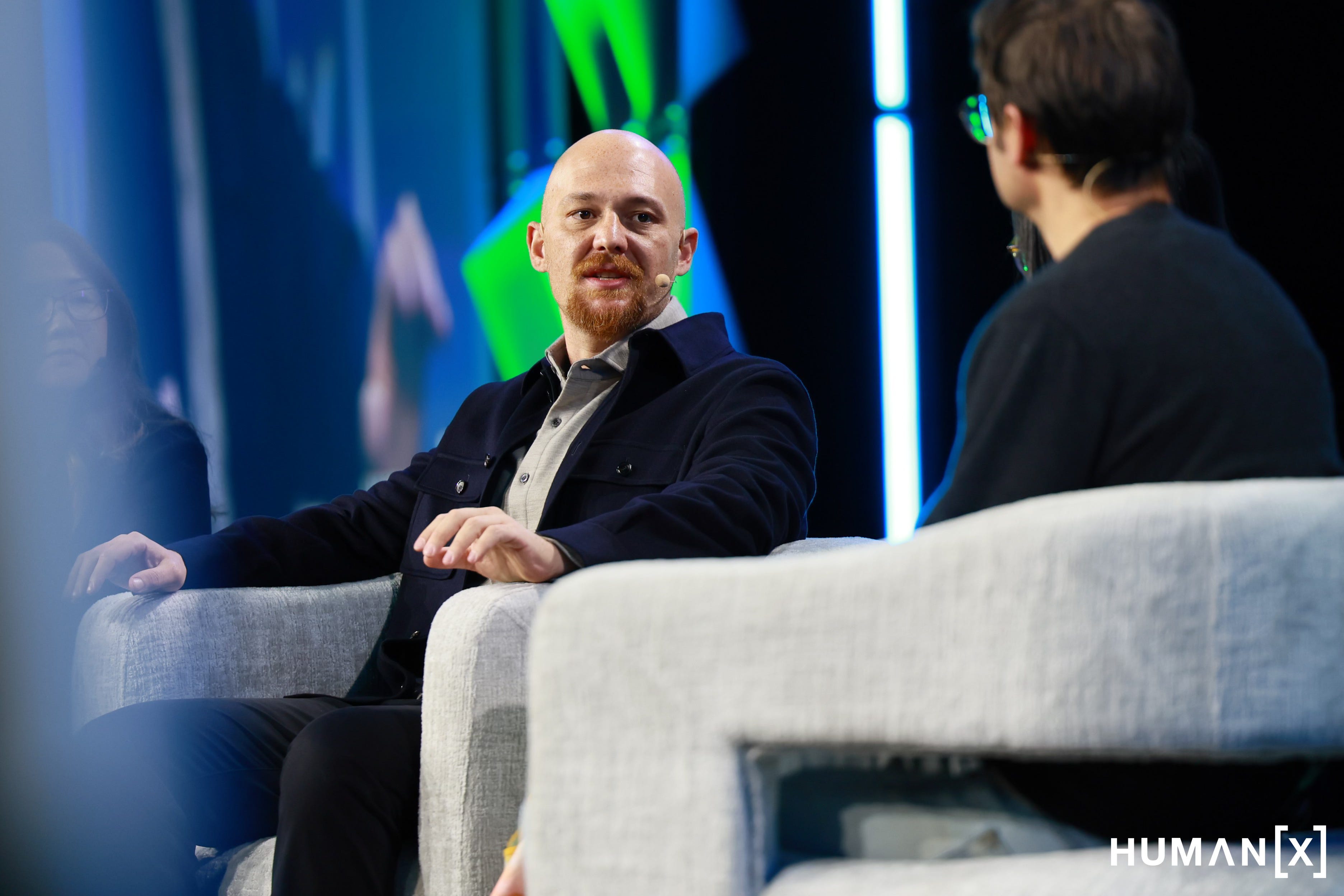
At HumanX this past week, I watched eight different tech leaders – including the CEO of AWS, the co-founder of Cursor, and the head of Anthropic Labs – describe essentially the same phenomenon without any of them naming it. A Novo Nordisk scientist asks a Databricks agent about adverse effects in an obesity study and gets referenced, percentiled answers in minutes; work that previously required routing through a data team over months. Anthropic’s finance department builds its own internal tools with Cursor despite having no coding background. Replit’s CEO watches board members and VPs walk into their companies with vibe-coded prototypes, telling their engineering teams “this is my vision” or, more pointedly, “why is this taking so long?”
The handoff machine
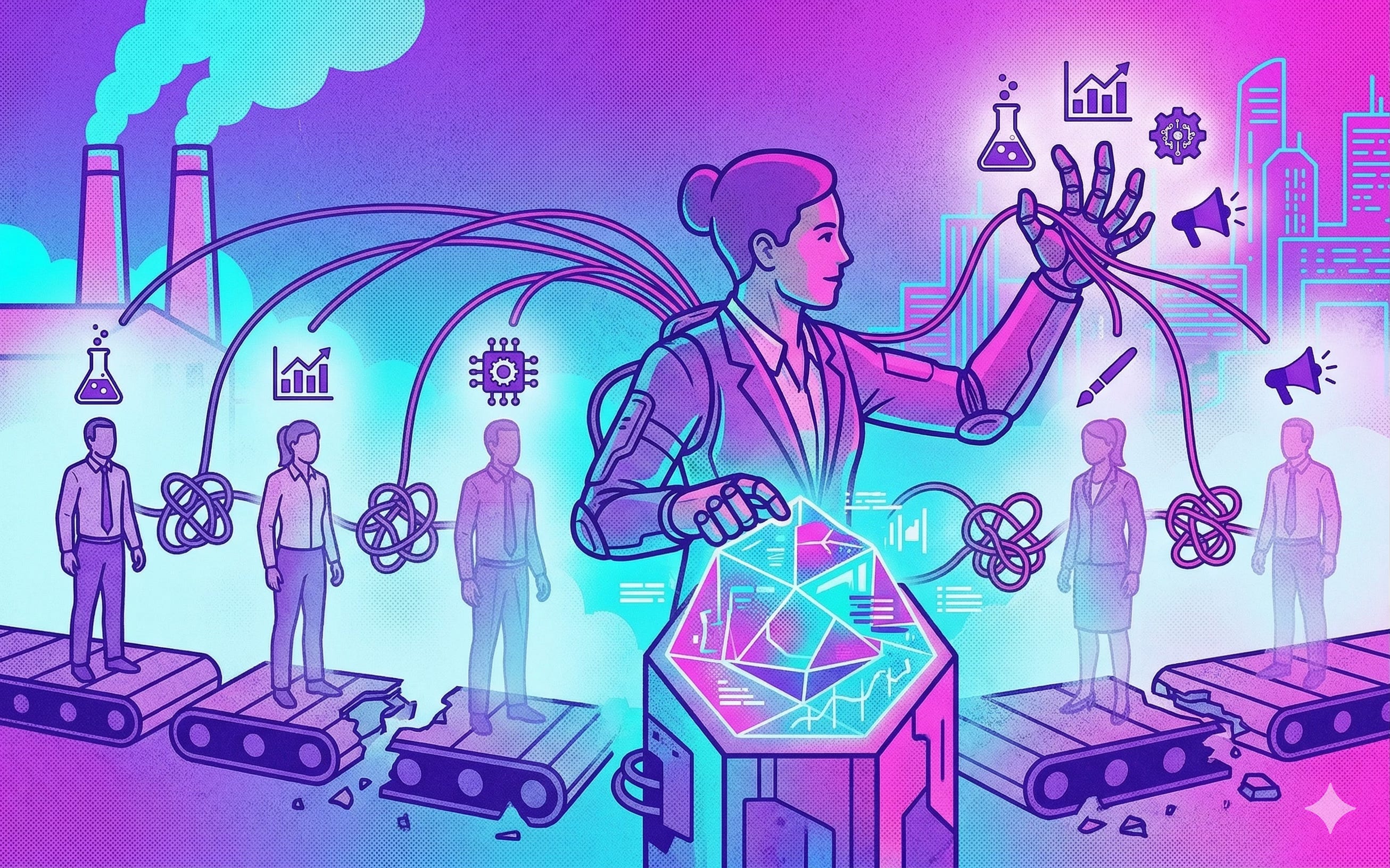
The narrative we’ve been hearing about AI and work is almost entirely about headcount: will jobs be created or destroyed? But what these leaders are actually describing is something structurally different. AI isn’t primarily replacing workers: It’s eliminating handoffs. And in so doing, it’s collapsing the division of labour that has defined how companies operate for the better part of a century.
The modern corporation is, if we’re being honest about it, largely a handoff machine. An idea moves from product to design to engineering to marketing, each transition consuming time, introducing opportunities for miscommunication, and requiring a layer of management to coordinate. A huge share of corporate headcount exists not to create value, but to manage the movement of information between people who do. A Medium analysis of AI-related layoffs in 2025 found that cuts clustered exactly in these coordination-heavy roles – “where work exists to move information, manage handoffs, and absorb friction.” Gartner’s prediction that 20% of organizations will use AI to flatten their structures by 2026, eliminating more than half of middle management positions, points at the same thing. The roles most at risk are those that exist because humans are slow at context-switching themselves, and bad at transferring context to each other, too.
Pulling the work back in
What I saw at HumanX was the other side of that coin – the reabsorption. People are pulling work back into their own hands that they’d previously just been forced to delegate. Matt Garman, the CEO of AWS, framed it through his sales organisation: reps currently spend maybe 20% of their time actually talking to customers, with the rest consumed by pipeline administration and preparation that used to require support staff. If AI flips that ratio, he argued, you don’t fire salespeople – you hire more of them, because each one can now support four times the customer relationships. The expansion is in the generalist role, not the support layer.
Bret Taylor, running Sierra and chairing OpenAI’s board, named something I think is genuinely important and underexplored. In the early days of a company, he noted, the most valuable person is often a great generalist – someone who’s “sort of an engineer, sort of a product manager, talks to customers,” who has real empathy for the end user and enough range to ship something end-to-end. Then the company grows, everyone has to specialize, and Taylor wonders aloud whether that forced specialization is correlated with “the enshittification of products,” the term coined and popularized by Cory Doctorow that describes a gradual decline in online products and services over time due to pressures on popular products in terms of maximizing profits. His real question: can that generalist now scale with the company, because AI handles the execution complexity that previously required breaking roles apart?
There’s already evidence this is happening. Michael Truell at Cursor reported that designers and product people – “technically light personas” – are now making changes in production codebases at enterprise customers. Mike Krieger at Anthropic mentioned his finance team building tools with no coding background. Eric Glyman at Ramp described a risk analyst who got frustrated with a 20-hour monthly underwriting process, screen-recorded his own workflow, and turned it into a 45-minute exercise.
I’ve felt this shift in my own work, too. I help run a PR and communications agency – SBS Comms – and over the past half-year I’ve been using AI to take entire campaign projects from strategy, through research and all the way to deliverable, solo, without pulling in the rest of the team. Not because I don’t trust them or because I’m trying to cut costs, but because the handoff itself was the bottleneck. By the time I’d briefed someone on the client context, explained the angle, reviewed a first draft, and iterated, I could have just done the thing – without signal loss. AI closed the gap between what I knew and what I could execute on my own. The result isn’t fewer people at the agency, though: it’s that the rest of the team can stay focused on their own priority work instead of getting pulled into mine.
These aren’t stories about AI doing someone’s job. They’re stories about people reabsorbing work they’d been forced to outsource to specialists or intermediary teams.
Ali Ghodsi at Databricks had probably the sharpest example. He described easyJet building an agent that can answer questions like “how many seats are taken on this flight from Paris to London?” combined with competitive pricing and historical demand data – the kind of query that used to require a multi-month engagement with a data team. The data team doesn’t necessarily disappear, but its gatekeeping function evaporates. The person with the question can now get to the answer without routing through three layers of organisational intermediation. That’s not automation in the traditional sense of replacing human-driven value-creation. It’s the disintermediation of internal expertise.
What gets lost
The shadow side of this is real and shouldn’t be glossed over. Korn Ferry’s 2025 workforce survey found that 41% of employees say their companies have reduced management layers, with 37% saying it’s left them feeling directionless. Middle managers held institutional knowledge, mentored junior employees, and served as a translation layer between strategy and execution – functions that don’t just evaporate because you flatten the org chart. Amjad Masad at Replit told a story that captures the emotional texture of this perfectly: he walked to work one day, the elevator opened, and an employee was standing there “dazed and confused,” muttering that “Zerg is taking over” – their internal code name for the AI agent that went from writing 0% of their pull requests to 50% in two weeks. The guy ran away and Masad hasn’t seen him since. It was a funny anecdote, but there was something underneath it that wasn’t funny at all.
Range over depth
What I find most interesting about the reabsorption pattern is that it reframes the entire debate about AI and employment. The “will AI take my job?” question assumes a static division of labour where AI slots into existing roles. But what’s actually happening is that the division of labour itself is being renegotiated. When a CEO can prototype, the power dynamic between leadership and engineering shifts. When a scientist can query clinical data directly, the relationship between domain expertise and data infrastructure changes. When a salesperson can prepare their own customer briefings, the support apparatus that existed to serve them becomes optional rather than essential. And in an ideal world, that support structure then becomes an entirely additive new value creation layer.
I’ve experienced a version of this myself – a media briefing document that used to involve a researcher, a writer, and a round of internal review is now something I can produce end-to-end in a fraction of the time, with AI handling the research synthesis and first draft while I focus on the strategic framing and client voice. The quality hasn’t dropped. If anything, it’s improved, because there’s no context loss between the person who understands the client and the person who writes the document. They’re the same person now. The function of what was the support and implementation team is now to focus on deeply understanding the customer and their industry and operating substrate in order to be able to parallelize and augment that process across the organization.
The career implication is fairly clear, even if nobody wants to say it this bluntly: range is becoming more valuable than depth. The person who can ship end-to-end – from idea through prototype through deployment – is increasingly worth more than the person who excels at a single link in the chain. Nielsen Norman Group, not exactly a hype-prone organization, recently documented “the return of the UX generalist,” noting that economic pressures will increasingly favour AI-augmented generalists over narrow specialists because the results are “cheap, fast, and good enough.”
That last phrase is going to make a lot of specialists uncomfortable, and it should. But it’s also probably the most honest description of where this is heading. The great reabsorption isn’t a story about machines replacing humans. It’s a story about humans reclaiming scope – and the organizational architecture that was built to manage their limitations quietly becoming unnecessary.
Disclaimer: Cursor and Ramp are clients of SBS Comms, my employer.